Publications and media
Assessment of future flood inundation under the impacts of climate change and human activities in Central Viet...
This study evaluates the combined impacts of climate change and reservoir operations on flood dynamics in the Vu Gia Thu Bon River Basin, one of Vietnam’s most flood-prone regions. The analysis employ...
How Can Public Development Banks Support the Energy Transition of Territories?
Energy policies designed at the national level produce different effects across territories and often prove insufficiently adapted to the diversity of local socioeconomic and environmental contexts. E...
Transboundary Climate Risks: A Cross-Regional Analysis
Prevailing approaches to climate adaptation still tend to focus on managing impacts within local or national borders. Yet climate change impacts do not stop at national boundaries: they propagate acro...
South Africa: Towards a Change of Course?
As South Africa faces major challenges—including chronic underinvestment, the inefficiency of state-owned enterprises, inadequate infrastructure, limited financial inclusion, persistently high unemplo...
SEMESTRIAL PANORAMA 2026 #2 International Economy: Did Someone Say “Resilience”?
Shock after shock, the global economy continues to surprise observers with its “resilience,” particularly when assessed through the lens of GDP growth. If the ongoing discussions between the United St...
Integral Inclusion: A Renewed Way of Supporting Youth Trajectories in Development Policies
International institutions, development banks, civil society organizations, and research institutions are paying increasing attention to the transition period between childhood and adulthood, marked b...
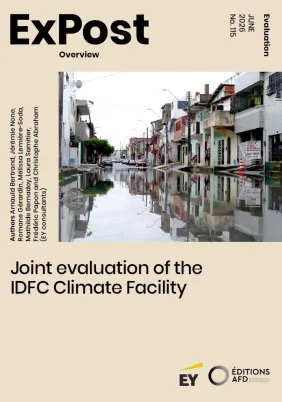
Joint evaluation of the IDFC Climate Facility
Founded in 2011, the International Development Finance Club (IDFC) is the leading group of currently 27 national and regional development banks worldwide, mainly from emerging markets. IDFC aims to pr...
Climate and Nature Economic Policy Scenarios (CNEPS) for Ministries of Finance, Public Development Banks, and...
This policy paper examines the growing role that Ministries of Finance, public development banks, and financial authorities must play in implementing the post-COP30 agenda. As climate risks intensify,...
Digital platforms in the domestic and care sector: A proposed taxonomy for Latin America and the Caribbean
Over the past decade, digital labour platforms for domestic and care services have become increasingly prevalent in Latin America and the Caribbean, albeit with varying degrees of expansion across dif...
Integrating Africa - From Threads to Hubs
Africa trades as much as East Asia relative to GDP but without the structural transformation. The problem lies not just in the volume of trade, but in its composition and direction: exports remain con...
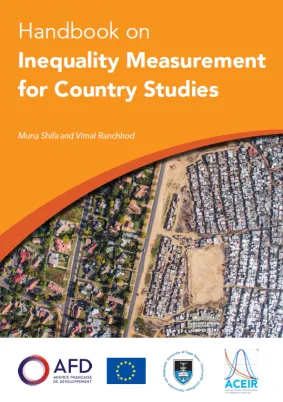
Handbook on Inequality Measurement for Country Studies - Updated version
Writing a country level study on inequality can be an intimidating task for researchers. How does one begin to conceptualize such a study? What needs to be included? What sorts of analyses are require...
Published on
Ukraine: Macroeconomics of War
The economic transition policies that followed the dismantling of th USSR led, due to a lack of gradualism, to a deep deterioration in Ukraine’s institutional balances, which weighed heavily, and cont...
Mobilizing strong sustainability indicators to achieve global durability goals
While the GBF and the SDGs pursue a vision of maintaining natural capital at a level that allows for sustainable socio- economic development, their monitoring systems do not use strong sustainability...
AIIPI 2026: AI Investment for All – A Multidimensional Path to Inclusive and Sustainable Growth - A strategic ...
The AIIPI is an index that measures the investment potential of 193 countries in responsible and inclusive artificial intelligence. It is based on the aggregation of 18 indicators grouped into six cat...
Does Climate Change Vulnerability Matter for the Allocation of Adaptation Finance? An Empirical Analysis of Do...
Climate change adaptation is a central challenge for sustainable development, particularly for the most exposed countries. While international agreements emphasize prioritizing vulnerable countries, h...
Historical and prospective dimensions of aging in the Western Balkans
The background paper provides literature review of Historical and Prospective Dimensions of Aging in the Western Balkans. It represents one of the most comprehensive regional analyses of demographic t...

Ethiopia: An Economy under Reconstruction
Since mid-2024, Ethiopia’s economy has been gradually emerging from crisis, supported by the implementation of an IMF-backed reform program. Focused on exchange rate liberalization, fiscal consolidati...
Nigeria: The Long Road from Stabilization to Development
In 2023, the Tinubu administration inherited a challenging economic situation, with Nigeria still bearing the scars of the 2014 oil price shock as it entered the COVID-19 crisis. The reforms implement...
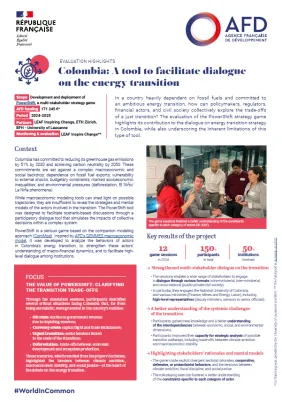
Colombia: A tool to facilitate dialogue on the energy transition
In a country heavily dependent on fossil fuels and committed to an ambitious energy transition, how can policymakers, regulators, financial actors, and civil society collectively explore the trade-off...
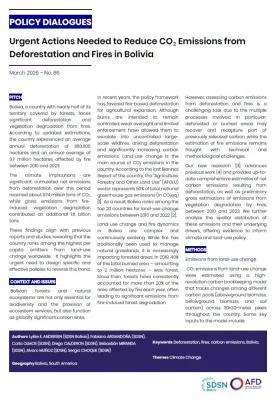
Urgent Actions Needed to Reduce CO₂ Emissions from Deforestation and Fires in Bolivia
Bolivia, a country with nearly half of its territory covered by forests, faces significant deforestation and vegetation degradation from fires. According to updated estimations, the country experience...
Managing Macroeconomic Vulnerabilities in Vietnam’s Energy Transition: A Multidimensional Policy Framework
Can Vietnam achieve a low-carbon transition by 2050 while maintaining its growth trajectory? With a real GDP growth rate of 8% in 2025 and a government target of 10% for 2026, Vietnam is one of the wo...