Share the page
Powershift Strategy Game: Supporting multi-stakeholder dialogue on Colombia’s climate action plan
-
Project start date
-
2024Status
Completed
-
Project end date
-
2025
-
AFD financing amount
-
171 245
-
Country and region
-
Partners
-
Research program
How can we better understand the behavior of the various stakeholders involved in Colombia's low-carbon transition? This project seeks to facilitate and promote high-level strategic dialogue around Colombia's energy transition through the design of a participatory process and the development of an interactive tool. Specifically, it aims to enable the exploration of different scenarios and support informed decision-making.
Context
Colombia, a country heavily reliant on fossil fuel exports, is actively working to complete its low-carbon transition and achieve its Nationally Determined Contribution (NDC) targets under the Paris Climate Agreement.
To support these efforts, AFD has partnered with Colombian authorities to adapt the GEMMES macroeconomic model to Colombia's specific context. The objective was to assess the long-term macroeconomic vulnerabilities and opportunities linked to Colombia's energy transition within the broader global shift to low-carbon economies.
This research work has culminated in a collaborative publication, which outlines the scientific findings and public policy recommendations derived from the GEMMES Colombia project: Modelling low-carbon transitions in Colombia: Macrofinancial risks and opportunities
While macroeconomic modelling is crucial for understanding the impacts of policy decisions and addressing macroeconomic imbalances during transitions, it is equally important to consider the behavioral aspects that shape the decision-making processes and strategies of stakeholders involved in Colombia’s low-carbon transition.
For further reading

Objectives
Based on the empirical results reflected in the GEMMES model scenarios, this project aims to develop a strategy game for the collective exploration of future scenarios. Beyond economic and financial aspects, it also addresses the energy transition by integrating social and climate dimensions, as well as, to a lesser extent, biodiversity-related issues.
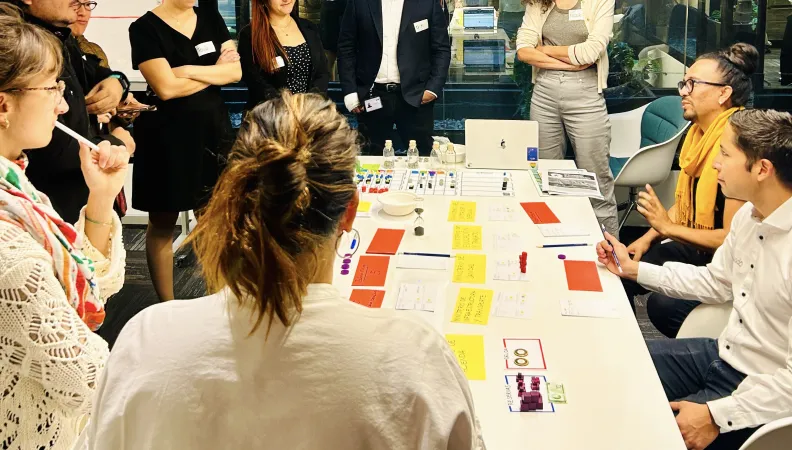
This participatory modelling process is designed to facilitate dialogue among key stakeholders in Colombia’s transition (ministries, central bank, entrepreneurs, researchers, etc.), enabling them to anticipate and prepare for the short-, medium-, and long-term macroeconomic impacts that a low-carbon transition may generate.
To this end, the serious game Powershift aims to:
- Familiarize stakeholders in Colombia’s energy transition with macroeconomic issues related to transitions, so they can take ownership of these topics;
- Identify the “mental models” of each category of stakeholders regarding the energy transition, in order to better highlight emerging tensions and synergies and help evolve perceptions;
- Make scientific frameworks accessible and engaging to support informed decision-making;
- Improve coordination between public institutions, economic actors, and researchers around energy transition challenges.
This project therefore seeks to strengthen high-level interministerial and cross-sectoral dialogue and, by extension, enhance coordination among stakeholders (including the private sector) in support of Colombia’s environmental commitments.
Method
The design, modeling, and implementation of the strategy game are grounded in the ComMod methodology, initially developed by CIRAD to facilitate multi-stakeholder processes and support collective decision-making and action.
The process includes modelling workshops with stakeholders, crash-test sessions, and game workshops involving policymakers, financial actors, donors, researchers, private sector representatives, and civil society. Key stages include conceptualization, validation, and scenario exploration. Participants are free to define their own strategies; any crises or tensions that arise during the game result from the collective decisions made throughout the sessions.
An ex-ante and ex-post assessment of stakeholders’ positions makes it possible to measure the effects of the approach on knowledge, interactions among actors, and participants’ strategic capacities. Debriefing workshops have been organized with policymakers to ensure effective ownership of the findings.
Results
The project has led to the creation of a strategy game that is now beginning to be used by Colombian counterparts to explore energy transition scenarios. To date, 3 crash-test sessions and 9 game sessions have been held, bringing together nearly 200 public and private stakeholders involved in the energy transition, as well as more than 50 different institutions. These include Colombian universities, ministries (finance, environment, labour, planning, housing, health, energy, agriculture, tourism), the central bank, financial supervisory authorities, commercial banks, research centres, international cooperation actors, NGOs, business associations, and consulting firms. Some sessions included the participation of vice-ministers.
The workshops helped strengthen dialogue at four levels: interministerial; cross-sectoral (with a strong diversity of public, private, academic, and international actors across all sessions); interdepartmental (notably through the mobilisation of the 14 departments of the Financial Superintendency); and public–private.
By mobilising this wide range of stakeholders, PowerShift has marked an important step in strengthening Franco-Colombian interministerial and cross-sectoral dialogue on the energy transition. Outputs include a project synthesis report, a research paper, policy recommendations, and knowledge-sharing materials. Key insights were shared through debriefing workshops with Colombian partners.
Find out more:
Research findings
Feedback from participants in the sessions indicates an improved understanding of the effects of the energy transition on the real economy of a country heavily dependent on hydrocarbon exports, as well as increased awareness of the associated challenges.
Key comments include:
- Importance of the co-construction process: Developing the game with Colombian partners allowed for the integration of the country’s institutional and economic specificities, which enhanced its credibility and stakeholder engagement.
- Creation of a pedagogical space conducive to dialogue: The sessions facilitated contacts with actors who had not previously been engaged.
- Flexibility and adaptability: The tool demonstrated its ability to adapt to different audiences, making it a valuable asset for a variety of stakeholders.
- Awareness of the complexity of energy transition dynamics: The game highlighted the interdependencies between economic, climate, and social issues, as well as differences in priorities between institutions, helping to better understand potential obstacles to public action.
- Illumination of behavioral dynamics: The sessions revealed that organized collective action primarily emerges in response to urgent issues or shared problems.
- Challenge of a holistic vision: Participants noted that developing a comprehensive view of the energy transition and actors’ strategies is particularly difficult due to the complexity of the subject.
- Success factors for participatory approaches: The involvement of high-level decision-makers and the existence of a safe dialogue space were identified as key factors in fostering participant engagement.
- Limits of the exercise in a short timeframe: While the game facilitates understanding of systemic dynamics, translating this understanding into actionable solutions requires complementary measures and long-term follow-up.
Building on these achievements, potential avenues for extension could include:
- Technical support for potential application of the tool at the territorial level;
- Facilitation of international exchanges to share best practices in participatory dialogue;
- Further strengthening of public–private partnerships through continued use of the tool.
To go further
Contacts
- Annabelle Moreau Santos, Scientific Mediation Officer, AFD
- Antoine Godin, Economist, Head of AFD Macroeconomic Modelling Team
- Julien Calas, Agronomist and Research Officer on Biodiversity, AFD