Share the page
How does AFD measure the impact of the projects it supports?
Published on

Ensuring the quality of projects is both a duty and an obligation for a public development bank. Each year, Agence Française de Développement (AFD) evaluates – and commissions evaluations of – the impacts of a large share of its operations, adapting to political, administrative, and operational expectations.
Impact evaluation is an essential tool for decision-making and for improving projects. This is highlighted on the occasion of the “Impact Measurement Summit,” held on 13 April 2026 at the Economic, Social and Environmental Council (ESCE) in Paris, France.
As a public bank for France and the UN’s Sustainable Development Goals, AFD has a responsibility to finance effective initiatives. The information generated and lessons learned from AFD’s evaluations are used to inform its continuous improvement strategy and thus realign its projects to improve quality and maximize impact. This data is also used as a basis for decision-making, dialogue with development stakeholders, and reporting of results to elected representatives, citizens and partner countries.
1. Before the project launch
Every financing project is subject to a preliminary (or “ex-ante”) analysis which is performed by a project team at AFD, with expertise in technical and financial operations. Projects also undergo a sustainable development analysis to assess the expected deliverables against the United Nations’ 17 SDGs. A “sustainable development opinion” is then issued by an independent entity from the operational departments, thus informing the decisions of AFD’s governing bodies (although certain categories of project are excluded from this process).
Impact assessments are also conducted as part of environmental and social risk management, in more or less depth depending on the level of risk, in order to assess and prevent negative effects on the environment and communities.
The results of these ex-ante analyses are then verified by several departments independent of the operational teams, particularly those responsible for risk management, compliance, and sustainable development assessment. AFD's teams can only submit financing projects to the Board of Directors for approval once all these rigorous checks have been completed.
See also: Where does AFD Group's global investment money come from?
2. During project implementation
Once the project is underway, the project manager can then put in place a monitoring and evaluation system that is used to steer the project's implementation.
AFD’s teams are required to monitor the project’s progress via reports submitted by project managers and field supervision teams, as well as audits by external consultants.
Nonetheless, not all projects go exactly according to plan and problems can sometimes arise. “In such cases, conducting an assessment midway through the project can be useful to help reset its course,” says Jean-Claude Pires, Director of AFD’s Evaluation and Learning Department. This strategy was applied to this forest conservation project in Madagascar, for example.
3. After project completion
Once a project has been implemented, AFD’s operational teams systematically draft a completion report which details the resources used, its achievements and results. A project evaluation is carried out in certain cases to help them identify what worked well and not so well, so they can plan for a new phase or analyze the impact of innovative projects.
The project team must either set aside a part of its budget for this evaluation in advance, or the decision will be made after its completion, following internal discussions at AFD (among the Evaluation Department, Technical Divisions, Regional Divisions and Administrators, for example) or with the French institutions involved, as well as with beneficiaries and project managers.
See also: AFD's Evaluations Report 2025
4. Several years after project completion
Certain projects are also evaluated several years after their completion. This generally takes place two or three years later, in cases where measuring the project’s long-term impact is deemed worthwhile. This type of evaluation is referred to as “ex-post”. “It’s important to ask the right questions at the right time. That’s why we take a customized approach to evaluation,” says Jean-Claude Pires. Various methods and tools are used depending on the type of project, including statistical analysis, satellite data, individual interviews, focus groups, and documentary analysis.
Read also: Measuring the impact of development projects using geospatial impact evaluation methods
In general, AFD’s project evaluations provide essential food for thought for teams looking to finance projects in the future. Not only do these assessments provide practical recommendations, they also help foster a culture of evaluation. They are designed to guide project managers in their own strategies and projects, and to ensure that all project stakeholders benefit from the lessons learned.
In total, around 50% of completed projects are subject to this kind of assessment. “This target is aligned with international best practices for financing agencies. We only evaluate a project if we can draw on the lessons learned to improve our operations,” says Jean-Claude Pirès.
Most of these evaluations are outsourced to external assessment firms. However, they are sometimes carried out by in-house experts who have not had any involvement with the project.
Project evaluation documents are publicly available here.
5. Complementary evaluations
AFD also performs three other types of evaluation:
Broad-scope evaluations focus on a theme, sector, geographic area, or financial instrument. They generally cover a broader scope and a longer time period than project evaluations. For example, AFD has evaluated its response to the COVID-19 pandemic through its Santé en commun initiative, which covered nearly 100 projects, as well as several projects using sport for development.
These broad-scope evaluations may also examine AFD’s sectoral, geographic, or cross-cutting strategies, helping to inform discussions with relevant partners. Most of these evaluations are made public through publication on afd.fr, in AFD’s ExPost series, or in scientific journals.
See also: Sports and Development: the Key to Success
Scientific impact evaluations address the current lack of robust scientific evidence on the effects of development actions. This type of evaluation, also supported by the Fund for Innovation in Development (FID), uses rigorous approaches drawn from social science research.
Scientific impact evaluations measure the effects of an AFD-supported project, including on populations and ecosystems, and identify those that can be directly attributed to the intervention. Once a causal link is established, successful approaches can be replicated elsewhere or scaled up.
They also support dialogue with partner countries on public policies, helping them identify and adapt measures across a range of sectors, including health, education, and energy. For example, this approach has been applied to the “Walang Gutom 2027” food voucher program in the Philippines, which aims to combat hunger and malnutrition.
Capitalization evaluations: based on the findings of evaluations or analytical reviews, as well as the experience of those involved, these capitalization activities prioritize a collective approach, involving several projects, to help operational teams gain a wider perspective on their practices.
Further reading
Serbia and Albania: projects driving closer integration with the European Union
Published on September 14, 2026
Climate change: a MOOC for more sustainable construction in the Mediterranean
Published on September 7, 2026

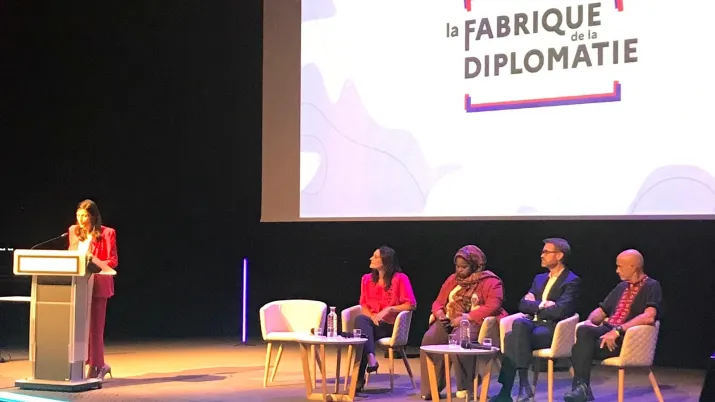
Development or climate action? Rethinking the choice at "La Fabrique de la Diplomatie"
Published on September 7, 2026