Share the page
Turkey
Turkey has undergone profound economic and social transformations. Its priorities today are to strengthen the resilience of its regions and infrastructure to natural disasters, develop its regional connectivity, accelerate its low-carbon transition, and preserve its water resources and ecosystems.
Since 2004, AFD Group has been supporting Turkish public and private stakeholders through these transformations, mobilizing both financing and technical expertise.
Context
At the crossroads of Europe, Asia and the Middle East, Turkey has experienced rapid growth and urbanisation over the past twenty years. Today, it faces three challenges: rebuilding and strengthening its resilience after the 2023 earthquakes, preserving its water resources and ecosystems in the face of climate change, and decarbonising its economy.
A partner of Turkey since 2004, AFD Group has committed €6 billion there through loans to public and private actors, funds delegated by the European Union, and technical expertise.
The AFD office in Turkey reports to the Enlargement and European Neighbourhood Regional Office.
Our approach
AFD and Turkey: Supporting the transition towards a more inclusive and low-carbon economy
AFD Group partners with Turkish settlements in moving towards a more resilient model that serves local communities.
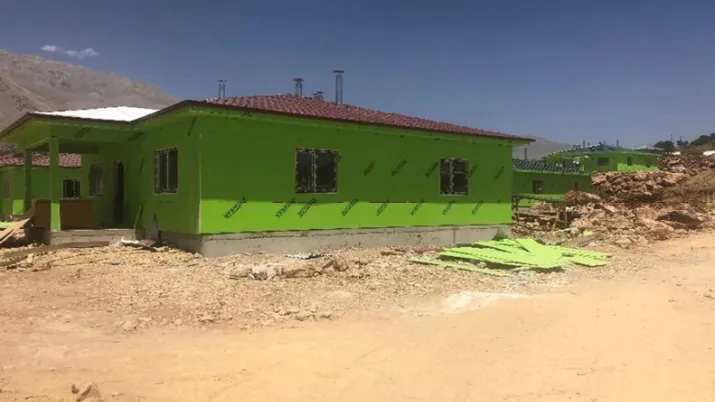
In the areas affected by the 2023 earthquakes, AFD and the World Bank are co-financing the reconstruction of 3,000 earthquake-resistant, energy-efficient rural homes, benefiting 10,000 residents. Through partner banks, AFD also supports the economic recovery and sustainable investments of affected businesses.
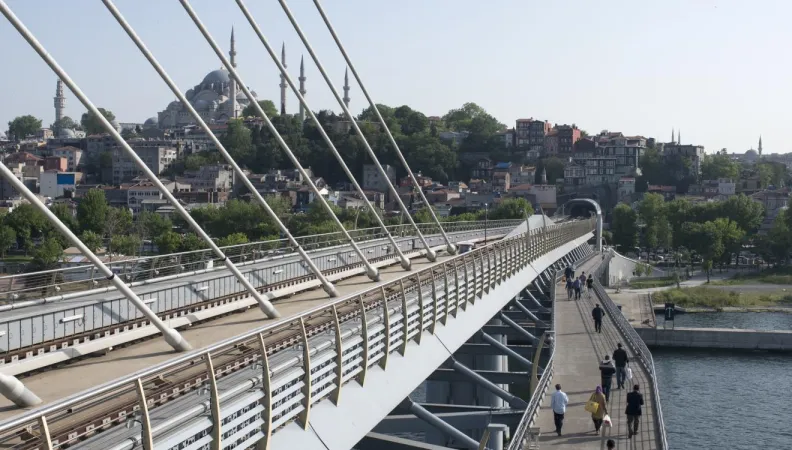
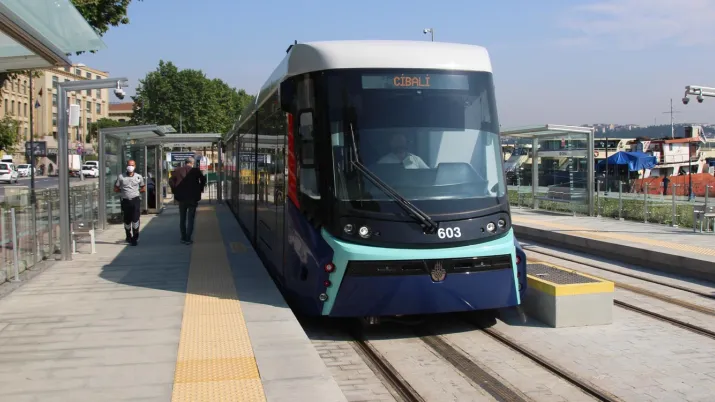
In major cities, AFD finances public transport (metros, trams and ferry services) that facilitates access to services and employment, while reducing congestion and greenhouse gas emissions.
Finally, AFD works with local authorities, either directly or through ILBANK, the local government bank. With technical assistance and support from the European Union, it helps improve access to drinking water, sanitation and waste management, notably through 20 projects in 8 provinces.
AFD Group works alongside Turkey to preserve its water resources, forests and biodiversity.
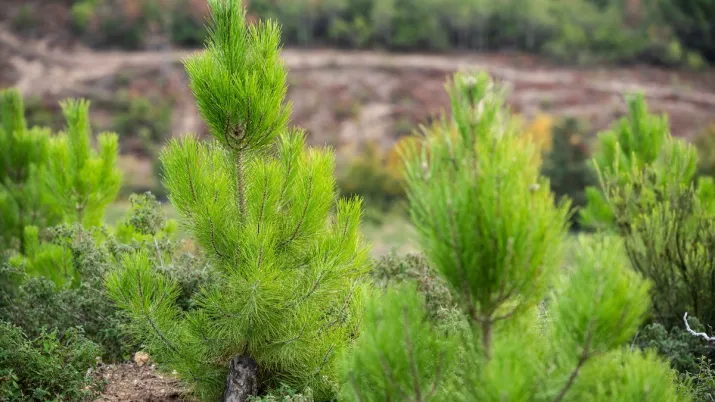
Building on a long-standing partnership with the Turkish forestry authorities, AFD promotes sustainable forest management, forest adaptation to climate change and biodiversity conservation. Franco-Turkish technical cooperation fosters the sharing of expertise and benefits rural communities. Between 2019 and 2022, the projects supported sequestered nearly 2 million metric tons of CO₂ equivalent.
In the face of climate change and growing pressure on water resources, AFD finances the modernization of drinking water networks and sanitation infrastructure. These investments secure water supply, improve wastewater treatment and reduce pollution of rivers and marine environments.
AFD Group mobilizes public and private stakeholders to accelerate the decarbonization of the Turkish economy.
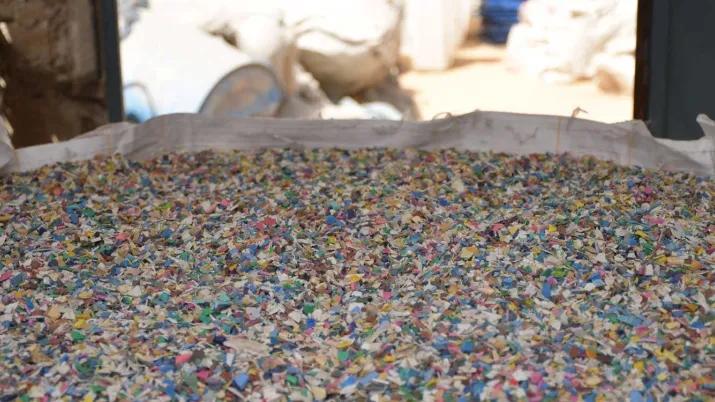
Together with Turkish banks, the Group develops financing for the low-carbon transition, enabling businesses and households to invest in renewable energy, energy efficiency and more resource-efficient industry. AFD also supports innovative financing solutions, including green bonds and the circular economy. With TSKB, 13 industrial projects are reducing raw material consumption and promoting waste recovery.
Alongside its financing, the Group provides technical assistance that strengthens partners’ environmental and social practices.
AFD Group places social and economic inclusion at the heart of its work in Turkey.
Through its partner banks, the Group finances women’s entrepreneurship, financial inclusion and access to employment.
In urban transport, AFD promotes safer mobility that meets women’s needs, while opening up jobs in the sector to women. In Izmir, 80 women bus drivers have been recruited and trained.
Through the VET4JOB-II program, Expertise France advances the employment of vulnerable populations by strengthening training, access to jobs and social cohesion. Nearly 7,000 people have been trained and around 3,000 have entered formal employment.
In the field
Below, find the country's projects, news, publications, and contact details in one click.
On the field
News & Press Releases
Publications & Media
Key figures
-
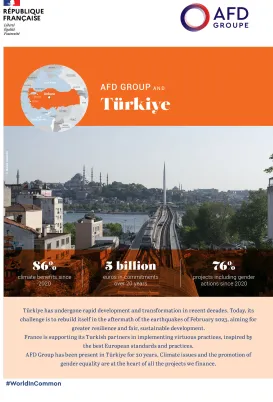
5 billion euros committed since 2004
-
76 % projects including gender actions since 2020
-
86 % climate benefits since 2020