Share the page
The Comoros
An archipelago of nearly one million people located off the east coast of Africa, the Union of the Comoros has significant assets. However, the country faces a range of structural challenges that hinder its economic and social development. As a neighbor of the island of Mayotte and particularly vulnerable to climate change due to its island geography, the Union of the Comoros benefits from substantial French government grants implemented by AFD. Priority areas for AFD’s support include social sectors, strengthening governance, and fostering economic development that respects the environment.
Context
A small island nation located off the coasts of Mozambique and Madagascar, the Union of the Comoros is made up of three islands: Grande Comore, Mohéli, and Anjouan. Its proximity to the island of Mayotte, along with a large Comorian diaspora living in mainland France and across the Indian Ocean – whose remittances account for nearly 20% of the country’s GDP – reinforces the strong ties between France and the Comoros.
The country’s economic situation remains fragile, with average growth barely keeping pace with population growth, which limits any real increase in GDP per capita. Despite some progress in recent decades, socio-economic development indicators remain low: the Comoros ranks 156th on the Human Development Index (HDI), and 36% of the population lives below the poverty line. As a small island developing state, the Comoros is also particularly vulnerable to the impacts of climate change.
Economic activity is limited and largely undiversified, with agriculture as the dominant sector. The country also suffers from energy shortages and water scarcity. The Covid-19 crisis and the fallout from the war in Ukraine further revealed the country’s high exposure to external shocks.
A partner of the Comoros for over 60 years, AFD works across around ten sectors, with a strong focus on social sectors such as health, education, and vocational training, as well as on economic development, governance, and biodiversity protection.
AFD operates primarily through French government grants and delegated European Union funds, financing projects that are mostly implemented by Comorian authorities. AFD also collaborates with civil society and French local authorities as part of their international cooperation efforts.
AFD's Comoros office is directly attached to the Indian Ocean regional office.
Our approach
AFD supports development in the Comoros
Progress made by the Union of the Comoros in achieving the Sustainable Development Goals “Good Health and Well-being” and “Quality Education” remains limited and uneven – largely due to a severe lack of funding for social services. Aiming to invest in the potential of its young population, the Comorian government has made strengthening human capital a key priority under the Emerging Comoros Plan 2030.
AFD supports this effort by making the health, education, vocational training, and youth inclusion sectors the main focus of its interventions – using integrated approaches that combine sector governance support, training, and infrastructure development.
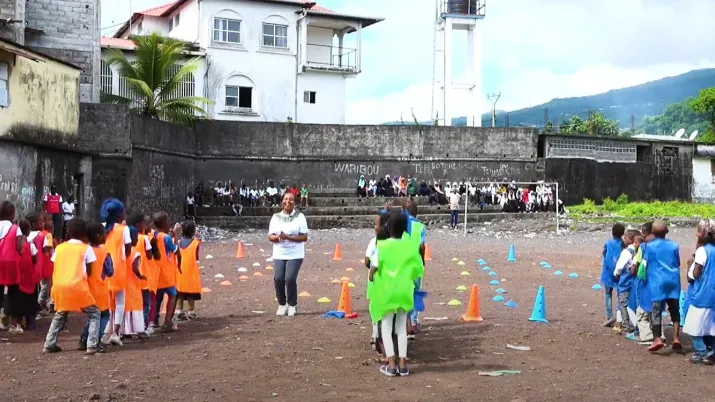
In the education sector, AFD aims to strengthen the social and economic integration of young people by supporting school infrastructure rehabilitation, teacher training, and the structuring of technical and vocational education and training (TVET) programs.
In the health sector – a longstanding area of AFD intervention – support focuses both on strengthening primary care services (such as health centers) and improving the quality of care in the country’s five referral hospitals.
AFD is also supporting the development of a universal health insurance system, the training of health professionals, and regional cooperation with facilities in Mayotte, Réunion, and countries in West Africa.
As one of the countries with the weakest institutional capacity, the Union of the Comoros must prioritize the strengthening of its public administration and civil service as a necessary condition for sustainable development.
AFD supports the authorities in improving administrative governance – with a particular focus on increasing tax revenue and strengthening public financial management.
AFD also contributes to improving the business environment to help grow the private sector and promote entrepreneurship. This includes support for the establishment of a banking guarantee fund for the benefit of micro, small, and medium-sized enterprises (MSMEs), a concrete step toward facilitating access to finance.
Lastly, AFD is active in the justice sector, supporting the training of judges and court clerks.
The Comoros is characterized by rich environmental assets, strong tourism potential, and promising agricultural and fisheries sectors. However, the country is highly vulnerable to climate change and extreme weather events, and faces intense human pressure on its natural resources.
AFD supports the implementation of integrated, territory-based socio-economic development initiatives, with a strong focus on environmental preservation. This support contributes in particular to improving access to water and sanitation, developing inter-island maritime transport, and strengthening export-oriented agricultural value chains – notably for vanilla, cloves, and ylang-ylang.
With nearly 400,000 Comorian nationals living abroad – including around 300,000 in France – the country benefits from a large diaspora whose remittances account for 20% of its GDP.
To channel these contributions into secure, productive investments that support the development of the Union’s three islands, AFD is financing a dedicated project aimed at promoting and encouraging entrepreneurial and community-led initiatives within the diaspora.
AFD is also supporting the regional integration of the Comoros by strengthening ties with neighboring countries – particularly in the agriculture and health sectors.
In the field
News & Press Releases
Publications & Media
Key figures
-
24 projects
-
€258 million in committments
-
10 sectors of activity